When I was a child, my grandmother taught me Chinese calligraphy hand-to-hand. This traditional cultural practice remains imprinted in my memory. Following my exhibition at The Arts House Trust in Auckland, I returned to practising calligraphy and began exploring its relationship to Chinese ink painting.
What began as an attempt to locate a specific hill—a metaphor for connection to land within traditional ink landscapes—gradually developed into an understanding of the horizon as a threshold between what is remembered and what is forgotten, situated within a framework in which memory, space, and identity are co-produced. Within this framework, migrant identity is not understood as a fixed cultural position, but as a process continuously negotiated and constituted across shifting spatial experiences and structures of memory.
My recent body of work, En Route, Finding My One Tree Hill, exhibited at Art Attic Gallery (Waihōpai) in February this year, extends this inquiry into my embedded cultural identity. In this work, I hand-stitched an aluminium mesh shanshui terrain, drawing on traditional Chinese landscape painting to translate an imagined two-dimensional space into a three-dimensional installation that viewers can physically move through. The installation is accompanied by ink paintings, presented in both traditional and expanded forms within the same gallery space.
Traditional Chinese shanshui (山水 / mountain–water) painting does not rely on a single fixed-point perspective. Rather than stabilising vision through a vanishing point, it unfolds through shifting viewpoints over time. The viewer’s gaze moves through the scroll, inhabiting multiple horizons rather than confronting a unified scene.
In this context, the horizon is not a fixed line dividing earth and sky, but a relational threshold that repositions itself through movement. Perspective is therefore negotiated rather than imposed.
The aluminium mesh landscape translates this spatial logic into three-dimensional form. The material renders landscape as light and permeable, forming a skeletal topography that recalls the gestural strokes of ink painting. As viewers move through the terrain, their bodily movement generates shifting sightlines and dissolving contours, without a single authoritative viewpoint. The horizon shifts with each step. This materialisation of moving perspective reflects perception as lived experience and informs my understanding of migrant ontology, in which identity is continuously negotiated across overlapping spatial and cultural frameworks rather than stabilised through a singular perspective.
— April 2026.
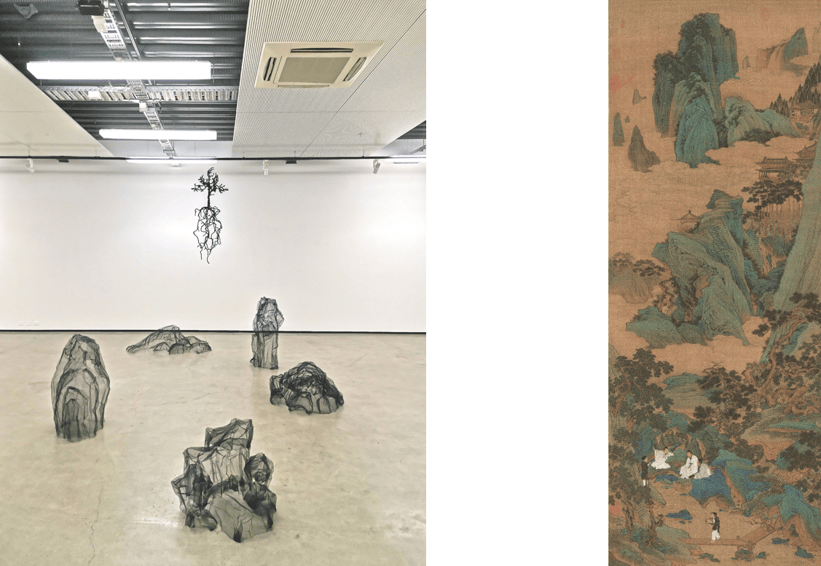
Left: Hand-stitched aluminium Chinese ink painting landscape, with a pipe-cleaner-wired tree, installation photo at Dunedin School of Art. (2025)
Right: A traditional Chinese shanshui painting by Qiu Ying (1482 – 1559), Fairyland of Peach Blossom. Ming Dynasty, Ink and colours on silk, 175cm*66.7cm. Tianjin Museum, China.
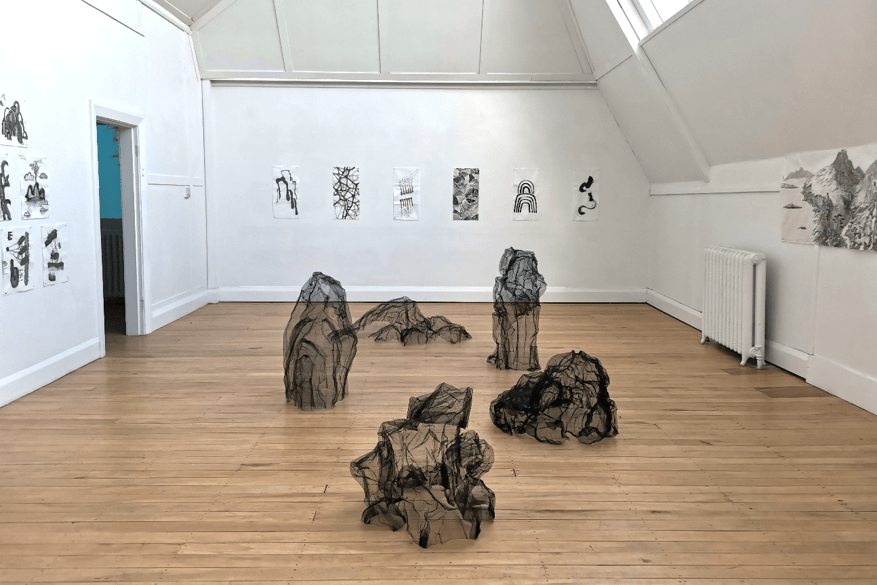
En Route, Finding My One Tree Hill (2026). Hand-stitched Chinese shanshui (山水/mountain-water) installation with ink paintings, aluminium mesh, pipe cleaners, and Chinese ink on Xuan paper. Installation view at Art Attic Gallery, Invercargill. Photo from Art Attic Gallery Archives.
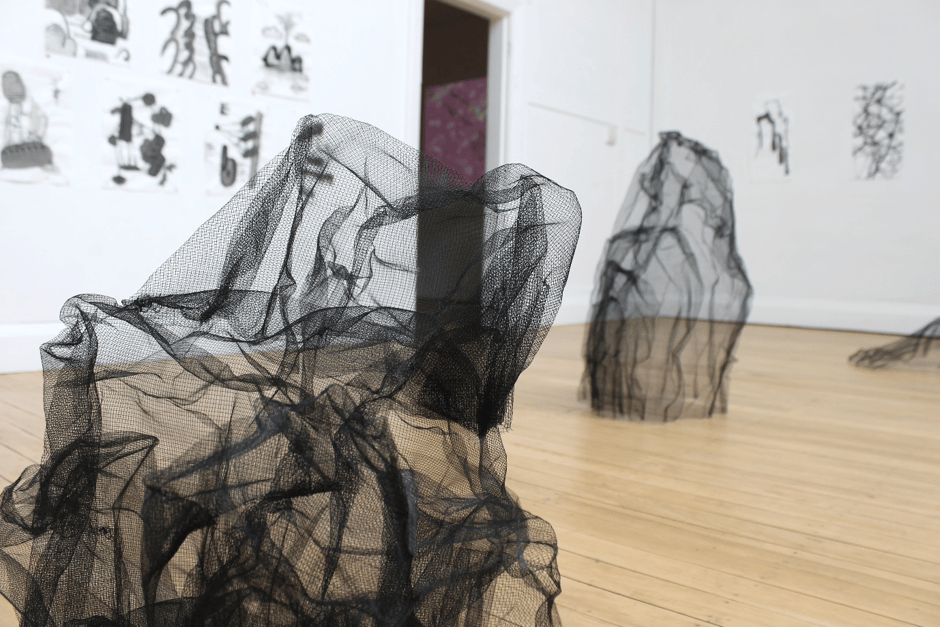
En Route, Finding My One Tree Hill (2026). Detail. Photo from Art Attic Gallery Archives.
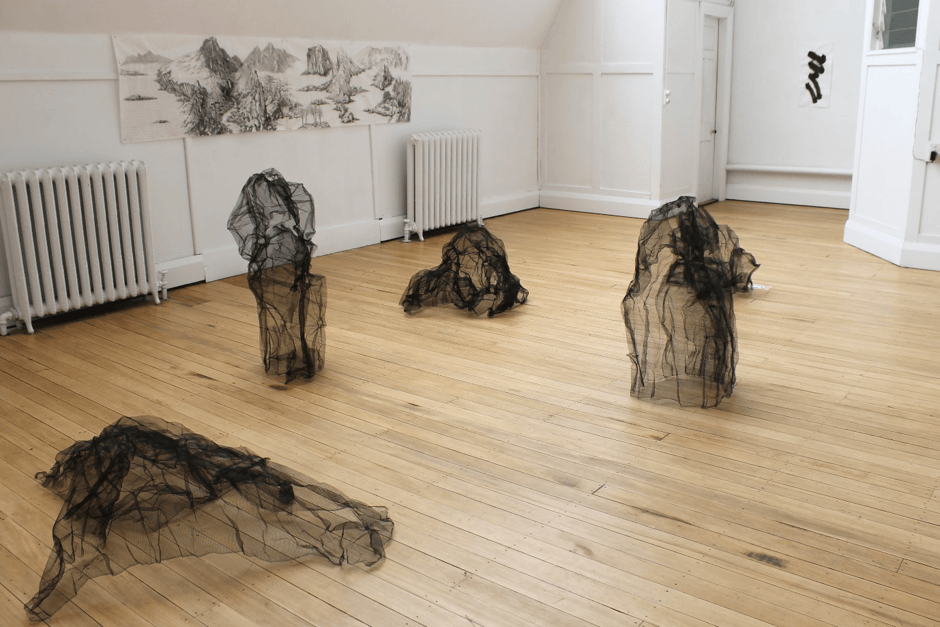
En Route, Finding My One Tree Hill (2026). Detail. Photo from Art Attic Gallery Archives.
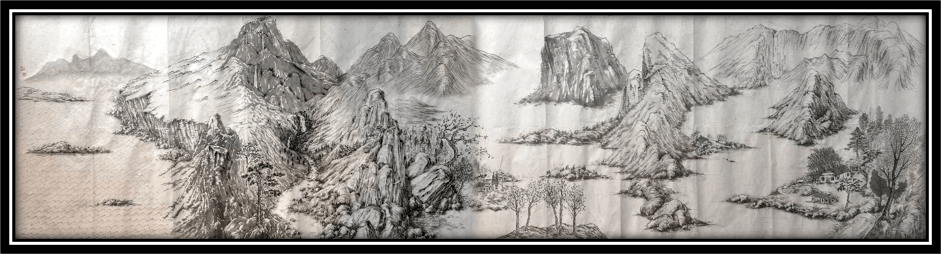
2800mm*700mm Full Scroll of my imagined living experience in Ōtepoti, reconfigured as a traditional Chinese shanshui, exhibited at Art Attic Gallery. Chinese ink on Xuan paper. (2026)
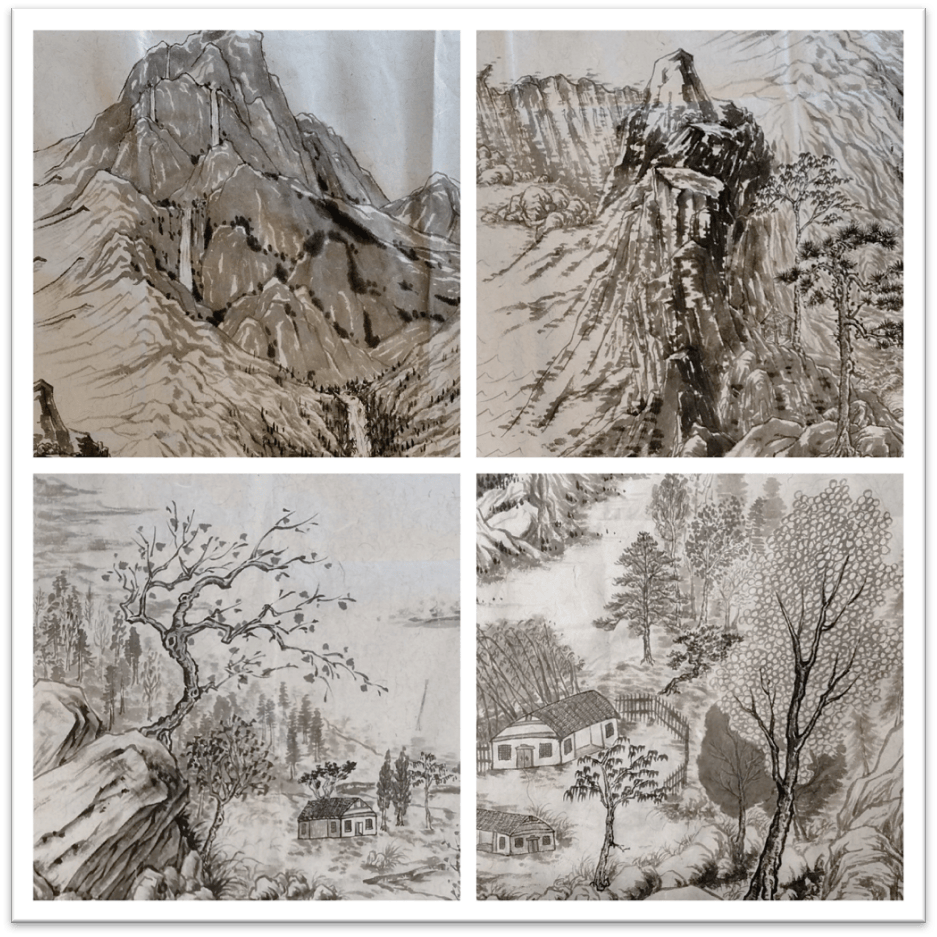
Full Scroll exhibited at Art Attic Gallery, Chinese ink on Xuan paper, 2800mm*700mm. (2026) Details.
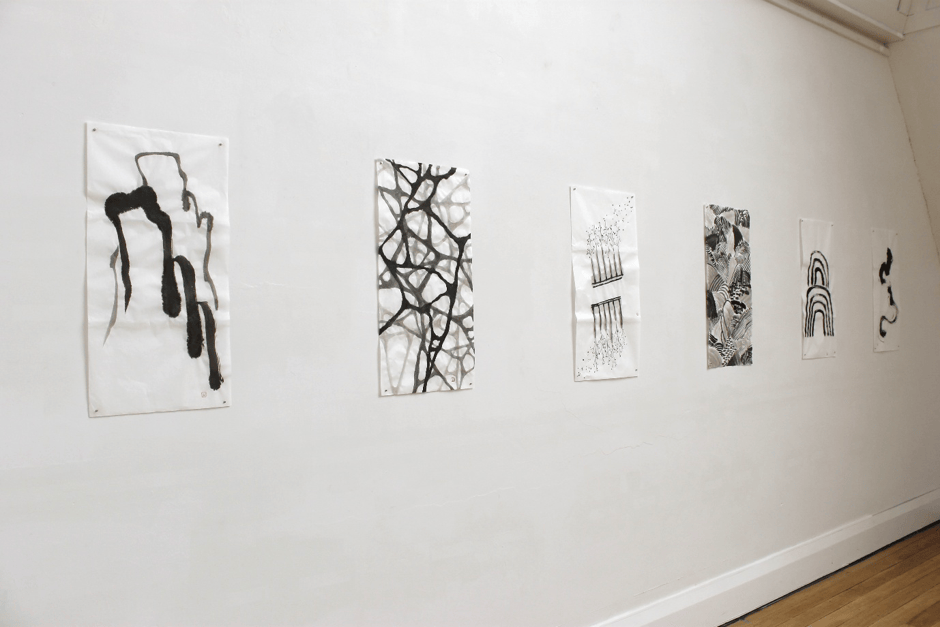
Other ink paintings are exhibited at Art Attic Gallery, Chinese ink on Xuan paper, 350mm*700mm. (2026) Photo from Art Attic Gallery Archives.
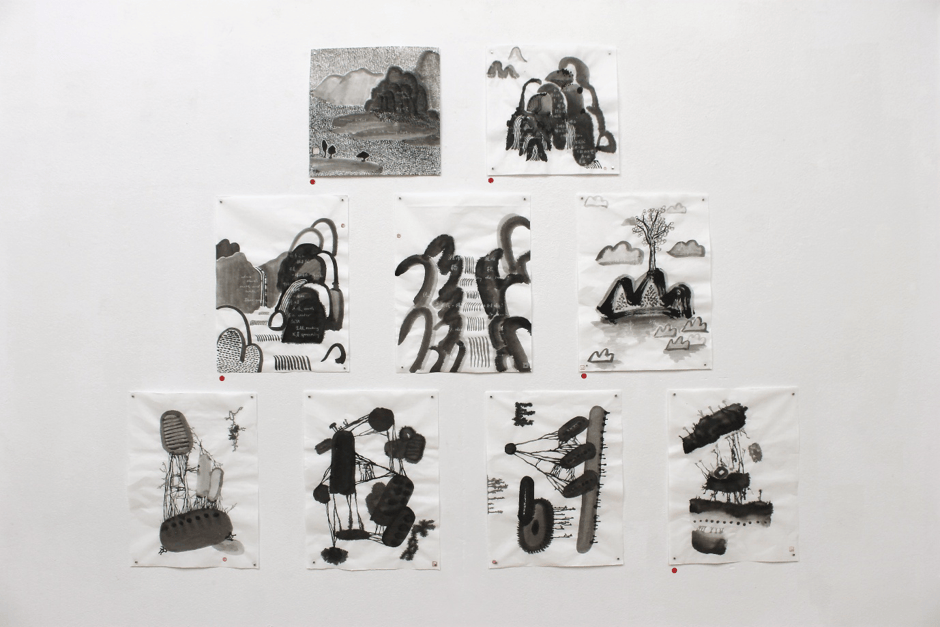
Other ink paintings are exhibited at Art Attic Gallery, Chinese ink on Xuan paper, 350mm*350mm and 350mm*525mm. (2026) Photo from Art Attic Gallery Archives.

