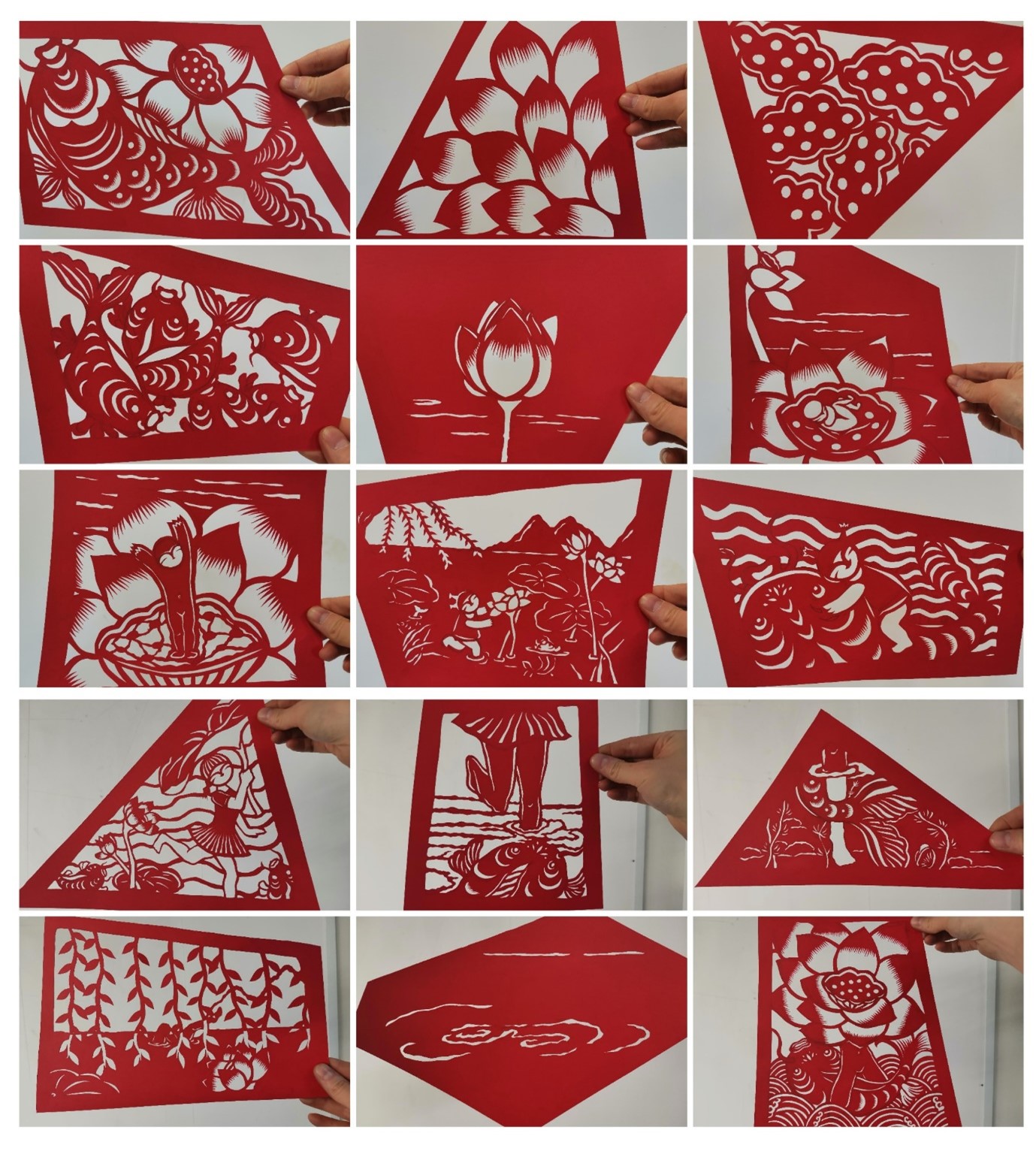
Being an immigrant living in a different but more open, gender-equal culture led me to consider how inherited forms can be reactivated to reflect my past gendered experience. In 2023, I engaged with Chinese paper-cutting art (Jianzhi), traditionally practised by women as a folk art form, as a way to reconnect with my cultural roots and to explore gender dynamics within a Chinese context. Drawing from traditional cultural motifs, I reinterpret these forms to address the historical and social expectations that have shaped the lives of Chinese women. In my practice, Jianzhi is not approached simply as decorative folk art; it expands into a narrative medium through which these conditions can be examined.
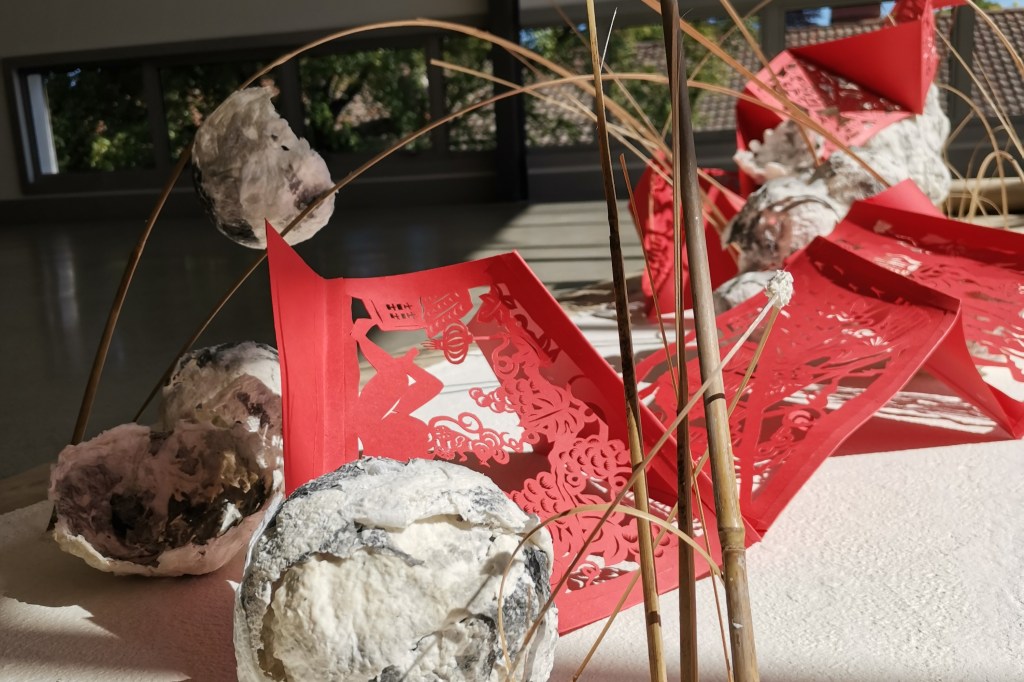
The work takes the form of three-dimensional Chinese ink painting scrolls. Constructed from papier-mâché and brown paper, the surfaces are marked by ink-traced impressions of my own footprints, registering my body as an identity. Each scroll is built upon bent bamboo frameworks derived from abstracted Jianzhi imagery and covered with fragmented ink paintings to create the three-dimensional scenes. The ink surfaces are made from handmade paper produced from shredded sanitary pad cotton, introducing a material directly linked to the female body. This material choice responds to the gendered hierarchy within traditional Chinese painting, where shanshui (mountain–water) landscapes—associated with power, status, and intellectual authority—were historically dominated by male painters. At the same time, women were largely confined to depicting domestic subjects such as flowers and garden scenes. By reconfiguring shanshui through a material tied to the female body, the work reclaims access to this visual and cultural domain.
Jianzhi elements connect the structures as irregular, unfolding narrative lines. Three motifs organise the work:
One, based on “Mouse Eating Grapes,” explores the condition of the “left-behind” population in a globalised context, bringing Western and Chinese symbolic systems into relation.
Another, derived from “Fish Playing with Lotus,” reflects on gender awareness and the experience of growing up within expectations of compliance, where the lotus signifies fertility and the fish suggests masculine power.
A third, based on the “Snake Coiling Rabbit” motif, examines themes of wealth, beauty, and exploitation, tracing how these forces continue to shape social relations.
Through the combination of material, structure, and narrative, the work re-situates traditional visual language within contemporary conditions, allowing multiple temporalities and cultural perspectives to coexist within the same visual field, offering a re-examination of feminism within a non-Western cultural context.
I am not a Tool for Carrying on the Family Lineage. Mixed media installation, 2023.