The yearning to reconnect led me back to my childhood memories. In those memories, the hand-sewn quilts my grandmother made always brought me warmth and a sense of care. Last year, I hand-stitched a quilt of my own, attempting to capture the craftsmanship my grandmother once embodied. Through the material and the act of making, I sought to reconnect with her, imagining my hands as her own—each stitch a quiet echo of our bond.
I took the quilt with me and revisited the old Chinese miners’ camp in Lawrence, where the first group of Chinese immigrants settled during the 1860s. There, I engaged my body in dialogue with the space, which became a part of a living perception in the moment of my presence—a “lived space” where memory and place converged.
“Throwing shā bāo(sandbag)” is a kids’ game every Chinese child remembers. A small hand-sewn pouch, filled with rice, beans, corn, wheat, or even sand—anything to give it weight. Two people stand on either side, tossing it back and forth, while the one in the middle dodges. If you’re hit, you’re out.
I was often the one hit—not only feeling the physical sting but also the quiet shame of being removed from the game. I remember once, someone’s shā bāo was filled with kidney beans; it hit my arm and left a deep bruise. I went home crying to my grandmother, angry and hurt. I begged her to make me a stronger shā bāo—something heavy, something powerful so that I could hurt them back. She listened gently, then said, If it hurt so much when they hit me, then why would I want to hurt someone else just by imagining how painful it would be? That moment stayed with me far longer than the bruise.
When I was making those quilts last year, I thought I was seeking the warmth and protection my grandmother once gave me. But I forgot that her love wasn’t just comfort or a shelter—it was also a quiet strength, a refusal to pass on pain. It was a choice. Now, as I am living in New Zealand, a place shaped by diverse languages and histories, I believe love remains a shared, universal force.
I went back again, following the Clutha River back to the historic goldmines of Lawrence and Arrowtown. Along the way, I collected fallen leaves and branches. There’s an old saying in Chinese: “落叶归根(luò yè guī gēn)”, literally means “fallen leaves return to their roots”; it expresses not only the circle of life in nature but also the deep-rooted human longing to return to one’s origin — whether a physical homeland, cultural identity, or emotional belonging — especially in the face of aging, displacement, or death.
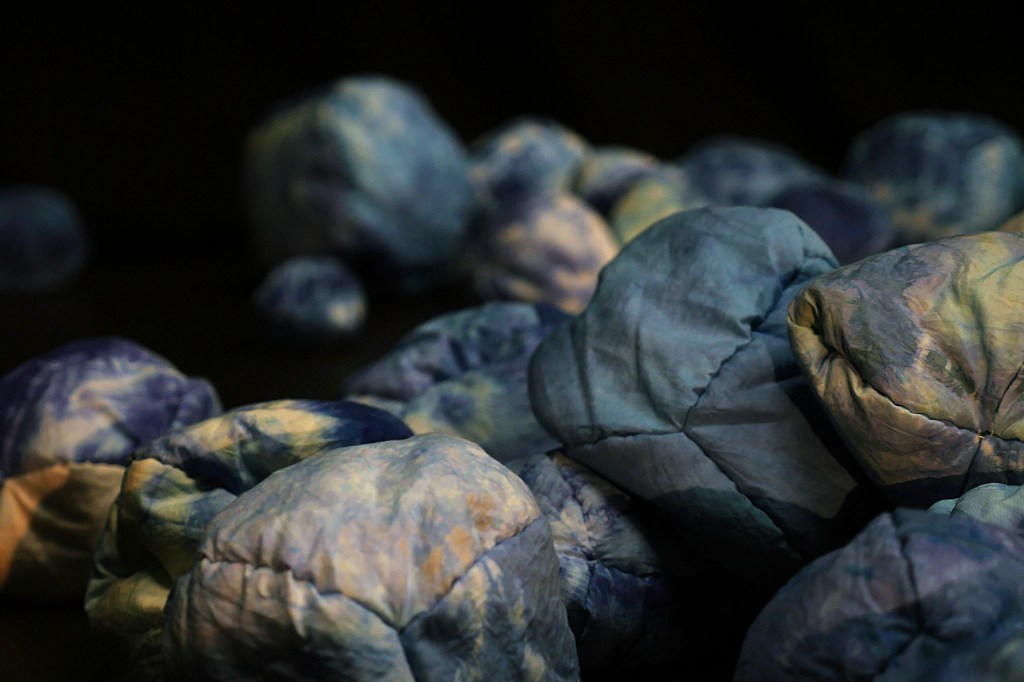
I then brought these fallen leaves and branches back to the studio, imprinting their traces onto white cotton through traditional Chinese tie-dye. These blueprinted fabrics are hand-stitched into shā bāo, filled with beans, wheat and grains, and quilted into a soft, comforting surface. In this, I hope to create a tactile, intimate dialogue between the reminiscences of my childhood, my grandma and my adopted land, and an exploration of cultural identity, cultural memory, and the quiet strength passed through generations of Chinese immigrants.
For me, traditional indigo blue printed cotton fabric is an inseparable material of nostalgia—it holds the collective memory of generations of Chinese people, carrying with it a sense of simplicity and sincerity. The grains used to fill the shā bāo—beans, corn, barley, wheat—are themselves everyday essentials. This act of storing food was a necessity for survival and a widespread cultural practice in China, shaped by the impact of wars and poverty.
Sewing the fabric became the primary method of making my work. In the repetitive act of stitching, it transformed into a ritual of journeying toward my traditional culture, which is now a part of my memory. As I unconsciously learned her ways of threading the needle, sewing, and knotting, I found myself reconnecting with my grandmother again and again—realising that the thread in my hand was the most immediate and profound strand of emotion I could hold.
Stones, in the memory of my growing up, had weight. They piled up in the river of time. I want these ‘stones’ to become softer and lighter; I also hope that the ‘stones’ in the rivers, in which once people searched for gold, will become softer and lighter too. History cannot be rewritten, and the river continues to flow to this day. But perhaps something kinder can begin to drift along with them.
Under The Bridge (2025)
Hand-stitched shā bāo filled with wheat, grain, and bean, and digital media installation.


 Eva During 伊娃卓灵